
You’re staring at the ceiling at 3 a.m., wide awake with thoughts that feel much heavier than they did in your twenties. Maybe it’s a new ache you can’t quite name or the way your energy suddenly dips mid-afternoon. You start to wonder: Is this just me?
After 35, the “whispers” of change get louder. We’re managing careers, kids, and aging parents while our own bodies navigate silent hormonal shifts. It’s easy to feel like you’re losing control or, worse, that you’re being “dramatic” for even noticing. Trust me, I’ve been there—Googling symptoms in the dark and feeling that tightening in the chest that’s half-half anxiety, half-half unfamiliarity.
But here is the truth: your body isn’t betraying you; it’s communicating. This season doesn’t have to be a crisis of “What’s wrong with me?” Instead, we can choose curiosity. In this post, we’re going to stop the silent worrying and start practicing self-advocacy. You’ll learn how to navigate these transitions with grounded confidence, moving from fear to a place of empowered awareness. You aren’t falling apart—you are evolving.
The Gentle Truth: It’s Not “Just Aging”
“It’s just aging.” It is perhaps the most dismissive phrase in the English language. It suggests that once we cross 35, we should simply accept discomfort, brain fog, or weight shifts as an inevitable decline. But at Vibrant Years, we refuse to dismiss. We explore.
The truth is, your body is in transition, not a freefall. For women, hormonal fluctuations—estrogen and progesterone playing musical chairs—often begin long before a formal diagnosis. For men, shifting testosterone can subtly alter energy and recovery. This isn’t a lack of discipline or a sign of weakness; it is physiology responding to life. We also have to acknowledge the “Sandwich Generation” reality. Most of us are carrying more weight than we did in our twenties—and I don’t just mean on the scale. We are balancing demanding careers, raising children, and worrying about aging parents. That stress isn’t just a feeling; it’s a chemical event. It spikes cortisol, messes with digestion, and disrupts sleep. Your body isn’t “failing” you; it is reacting to a high-pressure environment.
Let’s release the myth that if you were “stronger,” you wouldn’t feel this way. Midlife is a recalibration. It’s the season where muscle mass requires more intention and sleep becomes a non-negotiable ritual. When we replace uncertainty with gentle, grounded knowledge, fear loses its power. You aren’t meant to ignore your body or fear its changes. You are evolving—and evolution deserves curiosity, not criticism.
Naming the Shadows: What Actually Scares Us After 35
To find our footing, we must first name the fears. Naming them is like turning on a light in a dark room; the shadows immediately lose their power.
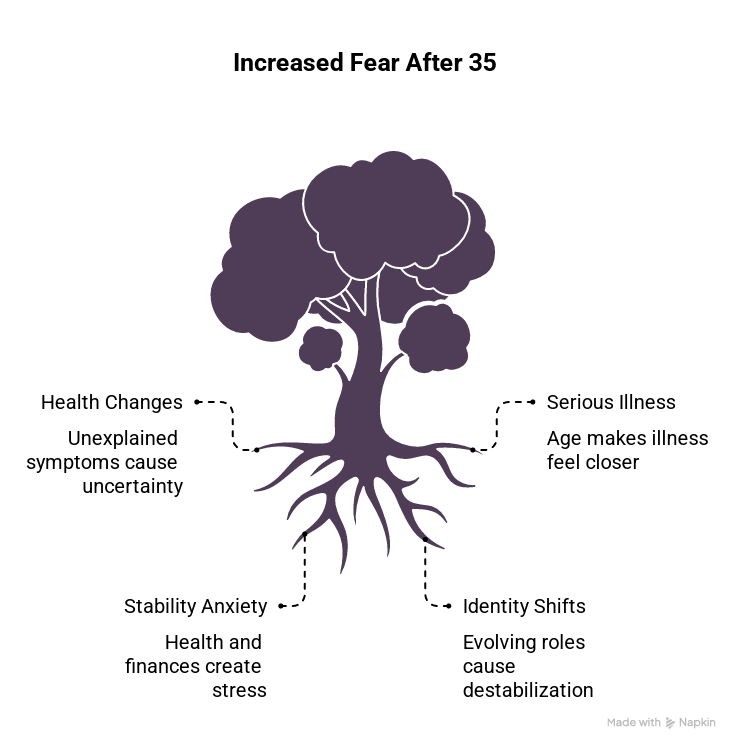
After 35, the primary fear is often uncertainty. When sleep becomes unpredictable or weight redistributes despite no change in your habits, it feels like a betrayal. But the real question isn’t “Why me?”—it’s “What is my body telling me?” Then there’s the proximity of illness. Suddenly, a friend’s diagnosis or a family member’s blood pressure reading feels deeply personal. This isn’t paranoia; it’s a heightened state of awareness. This is the perfect time to lean into proactive care. Reliable resources, like the Mayo Clinic’s guides on midlife transitions, offer grounded facts that replace “Dr. Google” panic with professional perspective.
We also cannot ignore the anxiety of stability. Most of us are balancing demanding careers, growing children, and aging parents. Our nervous systems carry this “sandwich generation” stress as physical tension or shallow breathing. If you’re feeling the weight of these roles, experts at The Gottman Institute provide excellent insights on navigating the emotional shifts that happen within families during these years.
Finally, there’s the identity shift. As our roles evolve, we inevitably ask: Who am I now? This isn’t a midlife crisis; it’s an evolution. By navigating this with curiosity and community, we turn silent anxiety into grounded confidence. You aren’t falling apart—you’re just layered.
From Fear to Forward Motion: Your Self-Advocacy Toolkit
So, how do we move from silent anxiety to grounded confidence? We stop being passive observers of our lives and start becoming the CEOs of our health. Here is how you can begin your self-advocacy journey today:
Trade “Dr. Google” for Data: Instead of spiraling in search results, start a simple “Vibrant Log.” For two weeks, track your sleep quality, energy dips, and cycle shifts. Having a paper trail turns a “vague feeling” into a concrete conversation for your next doctor’s visit. Data is the antidote to drama.

Interview Your Providers: Remember, you aren’t just a patient; you are a partner. If a healthcare provider dismisses your concerns as “just aging,” use your voice. Ask: “What physiological changes are causing this specific symptom, and what are our options for supporting my body through it?” If they won’t explore the why with you, it might be time to find a provider who will.
Audit Your “Inputs”: Our nervous systems are often over-caffeinated and under-rested. Prioritize the “Big Three”: consistent sleep hygiene, intentional movement to protect muscle mass, and five minutes of daily nervous system regulation (like box breathing).
Find Your Village: You were never meant to carry the “Sandwich Generation” weight alone. Whether it’s a therapist, a walking group, or our community here, find spaces where you can say, “I’m struggling with this,” and hear a “Me too” in return.

Self-advocacy isn’t about being “perfect”—it’s about being present.
From Whispers to Wisdom
Midlife isn’t a cliff; it’s a crossroads. Those whispers you’ve been hearing—the 3 a.m. thoughts, the shifting energy, the new questions—aren’t warnings of a breakdown. They are invitations to a deeper level of self-awareness. For years, you’ve likely been the pillar for everyone else, carrying the weight of careers, children, and parents. Now, your body is simply asking for its turn to be heard.
Remember, you aren’t “losing your edge.” You are sharpening a new one. This season is about trading silent anxiety for vocal advocacy and replacing fear with focused curiosity. You have the wisdom, the tools, and most importantly, a community right here that understands exactly where you are. You aren’t falling apart, friend—you are becoming whole.
Let’s keep the conversation going. Which of the “four fears” we discussed resonated most with you today? Is it the physical shifts or the “sandwich generation” stress? Share your thoughts in the comments below—let’s make sure no one has to navigate these whispers alone.
Leave a Reply