

We have all been there. It’s that quiet moment at the end of the month when you are looking at your bank balance and then looking at the calendar. You start doing the math in your head: ‘If I skip this, and move that, I’ll make it to Friday.’
When we were 20, we called this ‘living life.’ But after 35, that feeling starts to taste different. It feels like a weight. We start to realize that while we’ve been busy taking care of everyone else—our kids, our jobs, our parents—we might have forgotten to take care of our future selves.
I used to think that ‘Wealth’ was for people with big offices and fancy cars. But I’ve learned that wealth is actually just freedom. It’s the freedom to say ‘I’m okay’ when the car breaks down or the fridge stops working. Today, I want to share 5 simple laws that changed how I see every Rand that passes through my hands. It’s not too late to build your fortress.
Law 1 – The Law of the “Emergency Seed”
”In Soshanguve, we know that you don’t survive a dry season by eating your last bag of maize. You save it. You protect it. Because that seed is the only thing that ensures a harvest next year.
In the world of money, we call this an Emergency Fund, but I like to call it my ‘Sleep-at-Night Fund.’
Most people make the mistake of investing or buying ‘nice things’ before they have their seeds protected. Law Number One is simple: You must save for a rainy day while the sun is still shining.
Start with a goal of R5,000. It sounds like a lot when things are tight, but even R50 a week is a start. This money isn’t for a new outfit or a celebration; it is a wall between you and a crisis. When you have your Emergency Seed tucked away, you stop making decisions out of fear. You start making them out of power. Before you try to grow a forest, make sure you’ve protected your first bag of seeds.”
Law 2 – The Law of Lifestyle Inflation (The “Fancy Shoes” Trap)

”Have you ever noticed that the more you earn, the more things you suddenly ‘need’?
When we get a small raise at work or a bonus, our first instinct is often to upgrade. We want a better phone, a newer car, or to start eating out at nicer places. We tell ourselves, ‘I worked hard, I deserve this.’
But here is the secret the wealthy know: Wealth is not what you spend; it is what you keep.
Lifestyle Inflation (or ‘Lifestyle Creep’) is a silent thief. It’s when your expenses rise exactly at the same speed as your income. If you earn R1,000 more but immediately spend R1,000 more on a higher car payment, you are still exactly as broke as you were before. You are just ‘fancier-broke.’
To master this law, you have to decide that your future freedom is more important than showing off today. When you get extra money, try the 50/50 Rule: Use 50% to improve your life a little, but put the other 50% straight into your ‘Emergency Seed’ or your debt. This way, you enjoy your hard work today while still building a bridge to a better tomorrow.”
Law 3 – The Law of the Debt Avalanche (Stopping the Leak)

”Imagine you are trying to fill a bathtub with water, but there’s a giant hole in the bottom. No matter how hard you work or how much water you pour in, the tub never gets full. That is what high-interest debt does to your life. It’s a leak in your future.
After 35, many of us carry ‘bad debt’- “store cards (RCS, Foschini, Edgars), high-interest personal loans, or credit cards” . High-interest personal loans, or credit cards where we only pay the minimum. This is the most expensive money you will ever own. Law Number Three is simple: You must attack the debt that is costing you the most first.
We call this the ‘Debt Avalanche.’
1. List every debt you have and its interest rate (the %).
2. Pay the minimum on everything to stay safe.
3. Every extra cent you have—even R100—goes toward the debt with the highest percentage.
Why? Because that high-interest debt is a ‘negative investment.’ It grows faster than your savings ever could. By killing the biggest interest rate first, you stop the leak. Once that first debt is gone, you take all that money and ‘avalanche’ it onto the next one. You aren’t just paying bills; you are reclaiming your freedom, one percentage point at a time.”
Law 4 – The Law of Compound Time (The Patient Harvest)

“A lot of people my age say, ‘Madam, I’m 40. Is it even worth starting now? I’ve missed the boat.’
My answer is always the same: The best time to plant a tree was 20 years ago. The second best time is today.
Law Number Four is the Law of Compound Time. In finance, we call it ‘Compound Interest.’ It is the magic that happens when your money earns a little bit of interest, and then that interest earns interest of its own. It’s like a seed that grows into a tree, and then that tree drops more seeds.
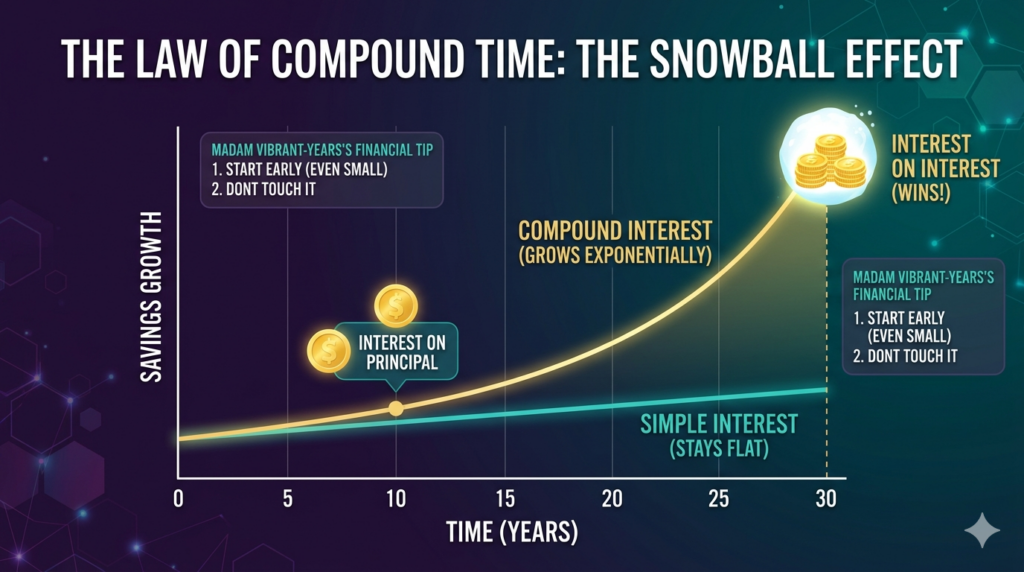
The secret is not how much you put in, but how long you leave it alone. Even if you can only save R200 a month, if you do it consistently and leave it in a growth account, it will eventually start growing faster than you can work. Time is the greatest employee you will ever have—it works 24 hours a day, it never gets sick, and it never takes a lunch break. Stop waiting for a ‘big’ amount of money. Give your small amounts the gift of Time.”
Law 5 – The Law of “Value, Not Price” (The Investor’s Eye)

”There is a big difference between a person who knows the price of everything and a person who knows the value of something.
Price is what you pay at the till—it’s the R500 for a pair of shoes or the R200 for a meal out. Value is what that thing actually does for your life over time. Law Number Five is the Law of Value: Stop spending money on things that lose value, and start investing in things that grow.
Most of the things we buy are ‘assets’ or ‘liabilities.’
A liability is something that takes money out of your pocket every month (like a flashy car with a high petrol bill).
An asset is something that puts money into your pocket or makes you more capable (like a course to learn a new skill, a laptop for your business, or quality tools).
When you look at your money, ask yourself: ‘Is this just a price I’m paying, or is this an investment in my future?’ When you start buying value instead of just ‘stuff,’ you stop being a consumer and you start being a producer. You aren’t just spending; you are building a legacy.”
The Conclusion:
”Which of these 5 laws do you need to work on the most this week? For me, it was Law #2—learning that I don’t need to ‘look’ rich to be building wealth. Let’s talk about it in the comments. Your Vibrant Years are just beginning!”
Leave a Reply